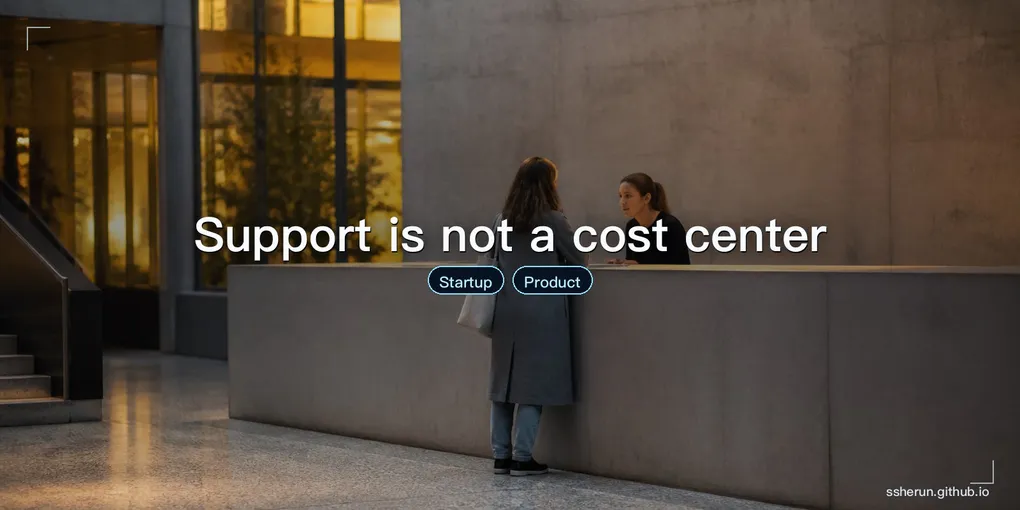
Support is not a cost center
For twenty years the internet optimized almost every commercial joint that could be optimized. Information got faster. Payments got smoother. Logistics got stronger. Prices got more transparent.
One thing never moved: people did not feel more regarded inside commercial systems.
Buy the wrong thing and try to reach support — you get a tree of buttons. A flight cancels — a queue and a template. An account looks “suspicious” — the system keeps proving who you are and never seems to care what happened.
The tech got stronger. The experience got colder.

Two layers of the commercial world
Commerce has long been split into two layers.
One is the mass market. Platforms, ecommerce, banks, airlines. They are good at standardization and supply at scale. They can serve a hundred million people, and each person’s presence in the system is thin. Your number matters more than your name. The ticket matters more than the feeling.
The other is the high end. Hotels, luxury, private banking. They sell more than a product. They sell being remembered, understood, anticipated.
A hard wall sits between the layers. It is not values. It is cost structure. Real high-quality service needs continuous attention, context, memory, and judgment — dense attention. Dense attention has always been expensive.
Jevons’ paradox
Economics keeps confirming a pattern: when the cost of using a resource collapses, people do not consume the same amount and pocket the savings. They consume much more.
Steam engines made coal more efficient; coal use rose. Email drove communication cost to zero; communication volume exploded by orders of magnitude.
High-quality attention will do the same. Once AI drives the cost of taking one user seriously toward zero, companies will not only cut the support budget. They will start doing things they could not afford: proactive care, ongoing companionship, personalization that is actually personal.
Demand is not replaced. It is released.
Redefining support
Old support was a cleanup department. It appeared after something broke. The goal was two words: cut cost. Far from growth, far from brand, far from core decisions.
When a system can actually understand a user, stay with them, notice problems early, and offer advice before they ask, it is no longer “after-sales.” It becomes the most important interface between the company and the person.
That interface knows what they bought, what broke, how they like to be spoken to, what they are sensitive to, when they are about to churn, when they are about to buy again. It exists across the whole lifecycle.
At that point support, sales, membership, CRM, and brand experience collapse into one interaction door.
Service is sales
The part a lot of people miss: when service is good enough, service becomes the best sales motion.
A hotel concierge can sell without sounding like a pitch, because they know you. The recommendation feels like a friend’s advice. You do not feel interrupted. You feel looked after.
Only high-ticket luxury brands could afford that “invisible salesperson.” AI can give every company a version of it.

Coldness becomes commercial inefficiency
Competition will shift from “cheaper, faster, more ad spend” toward “who understands the user, who can keep a relationship.”
When goods, content, and traffic are easy to copy, the hard layer is relationship. Cheaper deep understanding raises retention. The service process itself accumulates trust and repurchase. Feeling taken seriously is the real barrier in a commoditized market.
Once someone makes “understand you, remember you, take care of you early” the default, the whole market is forced to upgrade. You cannot define a product by feature-phone interaction standards in a smartphone era. You cannot define user relationships by ticket-queue thinking in an AI era.
Coldness is no longer just an experience problem. Coldness becomes a form of commercial waste.
What this means if you ship product
If you are taking desktop software overseas, the implication is direct:
Support is not something you invent after launch. It is part of the product. From day one, design what happens when something goes wrong. AI lets you offer something close to concierge service to every user, at a cost close to zero.
Products can be copied. Relationships are hard to copy. That is the moat.
References
- Original post
- Author: Ray Wang (@wangray)
Comments