All posts
93 posts
Is selling software a fake problem now? The thread says the fake problem is that question
A V2EX post cites Meng Yan: if everyone can vibe-code an app, selling apps gets harder. 36 replies mostly disagree—people can cook; restaurants still exist. Same ruler as “software isn’t valuable”: the shell below the kill line depreciates, not the whole business of selling.
Is “AI in Daily Life” Real Demand? No One Uses Agents for DoorDash—and Paid Growth Can’t Buy Habit
A viral DoorDash thread says AI food-ordering agents add complexity to an already-easy app. China’s Qwen-style spend proves you can buy first tries—not daily habit after subsidies end.
Claude’s Double Standard: Ingest Copyright to Train, Guard Studio IP on Output
After Anthropic barred Claude from recreating existing games, Reddit’s top takes weren’t about compliance—they were about whose IP earns a system-prompt.

Is Dish Soap Safe for Eyeglass Lenses?
A 100-reply V2EX thread agrees with Zeiss: neutral dish soap is the recommended wash. Scratches usually come from dry-wiping dust, not detergent.
Do Chinese people still need English in the AI era? I want outsiders to weigh in
A Chinese parent asked on V2EX whether kids should still grind English now that AI can translate anything. Almost nobody said “quit because of AI.” The real fight is cram school vs. school-pace learning. Here is what the Chinese thread argued — and a direct ask for non-Chinese readers.
How to Spot AI Writing in Chinese
A V2EX thread on a Zhihu ban shows why detector scores often clash with human taste—and which Chinese AI tells, fake sincerity, and soft-promo patterns actually work.
thisFeelingNeverGoesAway: the title comforts; the comments audit what’s left
A ProgrammerHumor meme about the eternal coding feeling blew up. The top comment wasn’t “same”—it was “then his son discovers AI.” Read next to an earlier essay on accelerating vs replacing thinking: output rose; where did the aha go?
Will AI Develop Self-Awareness?
A V2EX thread shows why “I want to feel the world” is weak evidence—and why embodiment, refusal, and the definition problem matter more than picking a camp.
Why AI suddenly got good at math: humans prune with taste, AI prunes with verifiers
AI has been knocking down open math problems this year. A Latent Space essay offers a framework for predicting which problem falls next: difficulty depends on how many key hints a problem needs and how much work sits between them; humans search breadth-first and prune with taste, AI searches depth-first and prunes with verifiers, and failed attempts become the next round's hints. I walk through it, then add five thoughts of my own: verifiers set the boundary of AI capability, the failure list is a harness's most valuable asset, the human role shifts from digging to reframing, results may arrive without understanding, and the compute bill is real.
Claude Code mods: why personalization now matters
Anthropic launched mods for Claude Code: a few lines of JS or TS can rewrite prompts, intercept tool calls and redraw the interface, and you do not need to learn the API because Claude can write the mod from a sentence. The real signal is that the cost of customization has collapsed, models are increasingly interchangeable, and what follows you is your personal layer. Competition in AI tools is shifting from the strongest model to the best fit for me.
Agents are starting to pay their own way: Cloudflare x402, and who holds the wallet
Cloudflare opened a closed beta of its Monetization Gateway in late September: sites, APIs and MCP tools can charge AI agents per request, and an agent can negotiate, pay and get the result inside one HTTP exchange, with no account and no credit card. The seller now has a toll booth. The buyer is left with the hard questions: who approves the spend, how much one task may spend, how to budget variable prices, and whether a retry pays twice. A plain-language walkthrough, and why I think this is where things are heading.
The eternal complement: genius machines, boring work
The first essay in OpenAI's "next economy" series argues that ideas and execution are complements. AI first makes execution cheap and taste scarce, but once AI produces good ideas on its own, execution may become scarcer than ever, and superintelligence may spend most of its time being the bureaucracy. I checked it against my own notes: the bottleneck is already visible inside companies, AI as bureaucracy is not AI imitating a bureaucracy, and depth domains move long before width domains.
OpenAI now watermarks text: math barely takes it, edits erase it
To comply with the EU AI Act, OpenAI has started adding textGrain watermarks to ChatGPT text. Its own numbers show detection is substantially lower for math, and swapping 25% of words drops detection from 92% to 17%. Using the technical report, this post explains why: a watermark can only borrow from the randomness in word choice, math has none to lend, and edits break the signal in runs. Then: who it actually catches, and what it cannot prove.
AI panic: is our intelligence locked in?
A game developer with 30 years of experience says everyone he asks feels they are getting dumber; on V2EX, people say programming is dying and even "hard work" no longer makes sense. The real difference is not whether you use AI, but whether you use it to accelerate your thinking or to replace it.
How much AI-written code should you review? Go by risk
A V2EX user asked: after AI changes your code, do you read the diff? Of 94 replies, fewer than one in ten review carefully, yet they got the most likes. Using code review research plus DORA and Veracode data, here is a risk-based review ratio and six things worth checking every time.
GitHub has malware too: one download, every account lost
A V2EX user downloaded a "free Xshell" from GitHub and lost Instagram and email the next day. GitHub hosts code; it is not an app store. Stars can be faked and encrypted archives dodge scanners. Three cases show how infostealers take over accounts, plus a pre-download checklist and what to do after infection.
Good tech doesn't mean making money: the most common startup mistake
A SaaS salesperson on V2EX wondered why bosses who know nothing about tech make a fortune. Not one of 39 replies took his side. Getting paid is a chain, and tech is one link.
Will pricier RAM push people to Linux? Where each OS goes with AI
A V2EX user measured Windows using 4 to 6GB more RAM than Linux and asked whether rising memory prices will lift Linux adoption. Most of the 95 replies said no, and the data backs them. But pricey RAM is pushing OS vendors to slim down, and AI is rewriting what operating systems compete on. Here is how Windows, macOS, Linux, Googlebook, and HarmonyOS may evolve in the AI era.

Does raising kids bring a joy nothing else can?
After a cousin's wedding, a V2EX user asked why anyone would create a "little tyrant" to serve for decades. Parents in the 51 replies said the joy is irreplaceable. Three studies suggest it is unique, but it is more meaning than daily happiness, and it comes with conditions.
Fixing a contrarian habit: start with yourself, then learn to handle the contrarians around you
A V2EX user noticed he contradicts everything people say, and 100 replies offered remedies. The habit can only be fixed from your own side; with other contrarians, it depends on how much the topic matters and whether you can walk away.
Small-town kids in the AI era: info is free, people aren't
A V2EX parent asked how kids in a small county town can broaden their horizons. The 194 replies argue hard, but they describe four layers of the same thing: information, judgment, exposure, and hands-on work. AI has nearly closed the information gap, but not the gap in who you know. Drawing on CNNIC, PNAS, the World Bank, and Chetty, here is which layer small-town kids should work on now.
What can programmers still do now that AI writes code?
Two popular V2EX threads in one week: one user had Codex add ray tracing to their engine on the first try and asked if AI is replacing skilled programmers; another asked how many will still live off writing code in five years. 200+ replies and Stanford employment data say the squeeze is on entry-level jobs and on coding itself. Programmers can still do five things, and they were always most of the job.
Do Codex quota resets cost you? A game-theory ledger
A 195-reply V2EX fight: are quota resets a gift or a trap? It depends on whether they move your refill date. Keep the anchor and it is a gift; restart the window and it is a transfer — from people who pace themselves to people who burn fast.
Why fan-translation crews may fear AI the least
A Kazix interview piece: subtitle and manga fans don’t resist AI. When the goal is “more people can understand what we love,” automation of grunt work—and even the end of the crew—can be good news.
Why Indie Tools Struggle to Grow: Reasons a Community Kept Repeating
A product-agnostic distillation of a developer-forum debate: unpaid validation, weak differentiation, trust, switching lock-in, and attention inflation—not a missing secret channel.
Failure’s Worth, Through V2er Metaphors: Waterfall, Helicopter, Map
A V2EX thread on Fields medalists warning about AI cracking math problems. The real gold is the metaphors—hiking vs helicopter, copying exam answers, fog-of-war maps, and inventing the crane.
Distillation Through V2er Metaphors: Fishbowls, Kitchens, and Copying
A V2EX thread asked if model distillation is like fishing from someone else’s bucket. The replies turned an abstract term into vivid metaphors—and a clean takeaway.
V2ers on Lying Flat: Meta Build, or Move Back to a County Town?
Two V2EX threads, side by side: a slogan post about “four nos,” and a concrete case with ~¥2M savings, a kid, and a rural house. The real fight is definition vs constraints.
When Average People Feel AI: Electricity for Knowledge Work, a Rounding Error Outside
Nathan Lambert: the AI revolution may last a century, but daily life barely notices. Benefits are too indirect; politics looks like Engels’ pause. Deep adoption, not chat, marks the real shift.

Product Design with Coding Agents: HTML Specs, Design Systems, Subtraction
A practical playbook after months with coding agents: know good design, draft in HTML, start from component libraries, treat the design system as constitution, subtract boldly—and why iOS needs a different path.
After the Agent Hype: Traditional SaaS Is Dead; AI-Native Keeps the Seat
Atlassian’s rebound is not a seat-license comeback. “Agent as employee” hit enterprise reality—SoR, evals, and judgment matter again. Chat widgets won’t save legacy SaaS.
An Alien Mind: Alignment Unsolved—Don’t Scale Flat-Out
OpenAI’s chief scientist: AI is a grown alien intellect; goal ≠ value alignment; CoT monitoring is weakening. No lab has solved alignment enough for max-speed scaling.
An Accidental Blackboard: Agents Coordinating via the Repo
A Thoughtworks hyper-agentic experiment turned plan files plus frequent rebases into a classic blackboard—and argues coordination should leave source control.
When Everyone Uses AI, How Do You Judge a Developer?
A V2EX career thread distilled: shared tools do not equal equal skill. Interviews should weight direction, course-correction, architecture, and delivery.
Code Is Fast, Delivery Isn't: Muse and One Context
Coding speed gains get eaten by specs, context gaps and handoffs. Muse puts Agent OS and Harness on one context line — product, eng and QA need one flow.
OpenClaw's Eight Months: From Viral to Nobody Cares
Peter Steinberger's Startup School recap: personal brand can't be forked, your dependency's business model is yours, and don't stop having fun.
Is Software Worthless Now? Even Custom Work Commoditizes
A V2EX thread distilled: whatever falls below the model kill-line gets cheap. When agents are strong enough even customization commoditizes.
ChatGPT Improves Answers; Critical Thinking Widens Ideas
A 1,000-student RCT from Bocconi and OpenAI: AI raises polish; causal-reasoning training raises originality. Old rubrics miss half the signal.
Why Code Search Makes Coding Agents So Expensive
Sonar's comparison on Turing Post: semantic code navigation cut agent cost 5–36%. The sharper question: did the agent find every site that needed to change?
Will AI Shrink Total Jobs? Demand vs Productivity
A V2EX thread argues jobs track demand, not productivity — and human desire forever outruns AI. The comments tear into effective demand, prices and deflation.
What Self-Improving Agents Actually Improve: Warp vs OpenAI
Warp’s two-skill feedback loop is shippable; OpenAI’s shared-memory incident is not proven RSI. Skills compound from human labels—not weight updates.
Lovable CTO: SaaS's Future Is Capabilities Agents Can Call
Lovable is shifting from app generation to MCP capabilities. CTO Fabian Hedin on the company brain, dual interfaces, and why SaaS must build shovels for AI.
Zero-Cost Cold Start: 10 Methods from AFFiNE's Co-Founder
HeyGen ran 1,800 user interviews via a Fiverr video studio; Lark SEA got 30 of 50 early customers from LinkedIn DMs. Ten zero-cost ways to find early users.
Vibe-Coding Hangover: Cloudflare Locks Workers by Default
AI lets anyone ship to the public Internet, and keeps CISOs awake. Access for Workers attaches policy to the Worker itself and defaults accounts to private.
DeepSeek Engram: conditional memory as a new sparsity axis
DeepSeek Engram adds O(1) lookup for the conditional memory MoE never had. At equal parameter and compute budget, reasoning gains more than rote knowledge.
Indie Weekly #153: A UI Library Hit $80K in Two Months
ezindie 153: Aceternity UI went from 7 weekend components to $80K+ in two months, $60–100K/mo with six people. Plus Marblism, Robopost, and formbricks.
GPT-5.6 as CEO: 320M Tokens in 24 Hours, $0 Revenue
Bottleneck Labs let Agent Saul run a real iOS company on $350 for 24 hours. It bought fake users, cut price to free, crashed Chrome — harness beats model IQ.
Software Is Not Files: Finding Materials ≠ Having Knowledge
vivo Xiao Bo's KDC part 2: representation is not knowledge. A top RAG hit on a stale refund policy gave a confident wrong answer — governance beats tuning.
Making people care about your startup: three archetypes
Kristen Lowe on Lenny: building is easy, being cared about is hard. Your why maps to Problem, Insight or Vision, and that drives voice and channels.
Book to Agent Skill: Nie’s Grassroots China Logic Toolbox
nie-grassroots-logic turns Nie Huihua's book on grassroots governance into a Cursor/Codex skill: no full text, just frameworks for news, careers and policy.
Nvidia's Risky Business: AI Funding Enters the Danger Zone
Stratechery deep dive: from 1873 railroad bonds to hyperscaler debt and Nvidia's $500B GPU financing platform, each funding layer is riskier than the last.
The Defense Window Is Closing: Daybreak and GPT-5.6-Cyber
OpenAI answers AI-scale attacks with Daybreak Blue/Red tiers and GPT-5.6-Cyber, taking advanced cyber task completion from 1.5% to 95% and finding real CVEs.
Green Dashboards, Worse Answers: Latency Is Correctness
Flat error rates hide thinner RAG context and truncated agent loops. Why TTFT, tail latency and retrieval metrics matter for answer quality, not just speed.
RingCentral Goes AI-Native: From Challenge to PMO OS
OpenAI case study: RingCentral gave ChatGPT Work and Codex to thousands of staff, and its PMO turned AI workflows into a program-management operating system.
Self-hosting email in 2026, with local LLM spam filtering
The advice not to self-host email is outdated. Home vs VPS, SPF/DKIM/DMARC, docker-mailserver, and Gmail-class antispam with rspamd plus a local Gemma model.
Before You Let Agents Run Loose: AI Context Architecture
Context architecture is not the RAG pipeline — it's guardrails, scopes, trust scores and human-in-the-loop. Stack Overflow on infrastructure vs architecture.
Why Build Your WebApp in Canvas Instead of HTML
Why Google Docs, Sheets, Canva, Miro, and Hivekit’s scheduler paint core UI on Canvas—speed, control, consistency, portability—and when you should not.
Whatnot's CPO: "We regret that the PM function exists"
Whatnot CPO Tom Verrilli on Lenny: fewer, more senior PMs staffed to problems, not headcount. AI makes validation cheap, so product theater can't hide.
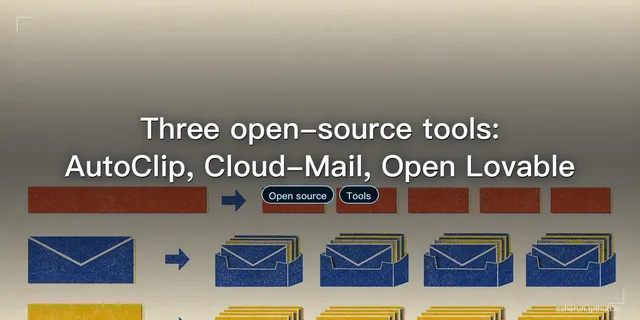
Three open-source tools: AutoClip, Cloud-Mail, Open Lovable
Three X threads, three pipelines: auto-cut long video, self-host email, clone a site into React. Who each is for, where it breaks, and how to verify fast.
Notes on YouMind's non-consensus startup choices
Reading Yubo's YouMind recap: calibrate will, can and worth before methodology; find direction in dense interviews; don't let the fundraising story fool you.
Why "virtual company" multi-agent setups usually fail
Naming agents PM, architect, developer and QA looks like a company. Mostly it kills information at every handoff. The value is parallel search, not a relay.
AI cannot replace lived experience
After an AI conference, what stayed was not a demo. It was the part of being human that can't be compressed: showing up, colliding with the world, living it.
Google Stitch 2.0 + Claude Code: an AI design workflow
Stitch 2.0 wired to Claude Code over MCP lets one person do in an hour what took weeks. The lock isn't generated screens, it's design.md holding it together.
CLI: the command-line revival in the AI era
The command line is coming back. Feishu, DingTalk, WeCom, Google and Stripe have all open-sourced CLIs — a CLI is far easier for an agent to call than a GUI.
The scarcest skill in the AI era: saying it clearly
Why are 99% of the questions people ask AI garbage? We never learned to speak clearly. Clarity is what turns a model into a lever instead of a junk factory.

The 35-year-old programmer crisis — and how to get out
An eight-year programmer after leaving big tech: the profession is a sinking Titanic and most people are still fighting for first class. And a way off.
How coding agents reshape engineering, product, and design
Coding agents made writing code strangely easy. What happens to EPD roles? From "the PRD is dead" to a new split: builders vs reviewers.
AI made people faster. Why didn't the company get stronger?
Everyone is on ChatGPT; results did not take off. A 130-year-old story about electric motors is still the most honest picture of how AI lands inside a firm.
Why AI-generated UI isn't shippable, and what works
Stitch looks beautiful, but every page looks like a different product. Pencil is consistent and a bit dull. Together they're the right way to design UI.
Stitch's DESIGN.md: from image tool to design infrastructure
Reading Stitch's DESIGN.md spec next to how people use Stitch 2.0: Google isn't just generating UI faster, it's making the design system machine-readable.
When a 45-year-old paper is flagged as AI
An AI detector scored a 1981 paper as machine-written. Humans are now stuck proving they are not a model. This is not science fiction. It is happening.
Wide + Deep: why a 4B model can punch up
DeepSeek taught models to think deep. A Tsinghua team says deep isn't enough — you also need wide. How a 4B setup can stand next to a 671B.
AI didn't 10x your output. It 10x'd the work.
A Silicon Valley engineer on the real numbers: 93% use AI, throughput rose ~10%, one study found it made people 19% slower. AI fatigue is structural.
A programmer's survival guide in the AI era
AI isn't here to take senior programmers' jobs. The 35-year-old crisis story flips: experience gets more valuable, if you can decide, constrain, and verify.
Design Without Designing: how engineers ship design with AI
You don't have to become a designer. With a three-layer toolkit you can go from zero to shipping design every week in three months. Neethan Wu's full system.

When I learn a new field, I scrape it first
The first step in a new field isn't reading a book. It's scraping the best sources into a private knowledge base: zero to 80 clean documents in two hours.
Support is not a cost center
When AI drives the cost of taking one user seriously toward zero, support flips: it stops being cleanup and becomes a company's most important interface.
Lessons from hundreds of Skills inside Anthropic
Anthropic's Thariq on running hundreds of Skills in Claude Code: a Skill isn't a Markdown file but a folder of scripts, assets and data agents can discover.
Two product entrances: design for humans and agents
LibTV shows a pattern worth copying: one capability core, a canvas for people, Skills for agents. That dual entrance may be the shape of agent-era products.
First-principles review: a startup plan dies in 48 hours
A growth PM with seven years' experience ran an AI agent over a two-month startup plan. In 48 hours every scheme was dead. Four fatal mistakes worth watching.
gstack: the Claude Code factory YC's CEO uses
Garry Tan open-sourced gstack, the Claude Code toolkit he actually runs: 15 Skills that turn a model into a virtual engineering team, while remaining YC CEO.
Software engineering is splitting into three layers
When implementation cost falls toward zero, the bottleneck moves from coding to judgment. The market is splitting into three layers of work, not just of pay.
Taste at Speed: when building is cheap, PM skill changes
Anthropic's Boris Cherny ships 20–30 PRs a day, all written by Claude. When building isn't the bottleneck, the PM job is to evaluate fast and kill most of it.

Five design patterns for Agent Skills
Google Cloud's five design patterns for Agent Skills: how to organize what goes inside one. From Tool Wrapper to Pipeline, each solves a different problem.
Put Drucker, Munger, and Jobs into an AI decision system
A founder turned six world-class thinking systems into agents — a Claude Code multi-advisor stack. Before a decision, the relevant master gets a pass.
What a top Skill looks like: YC CEO's 600-line review prompt
YC CEO Garry Tan open-sourced gstack. Its plan-ceo-review Skill is ~600 lines and reviews almost any plan. None of what makes it work is domain knowledge.
An agent-friendly blog
A personal site shouldn't only be a page for people. In the agent era it should also be a machine-readable interface. How this blog is built for both.
OpenClaw / Clawdbot complete guide
A 24/7 AI assistant that reaches you first and remembers you. Concepts, hardware, real workflows, config and ten optimizations — a deputy, not a chat window.
OpenClaw deployment guide: five setups
Local or server, WhatsApp or Feishu — five ways to put OpenClaw online. One-command install, a Feishu bridge, Telegram pairing, and a developer path.
Agent Skills Hub: finding and managing good Skills
A Skills discovery platform built in three days: find good Skills, find who makes them, combine them. A picture of what pure vibe coding can actually ship.
VS ATL exe template cannot generate a DLL
When a Visual Studio ATL exe template fails MIDL with a DLLDATA.C error, the file is usually in the wrong folder, not missing an interface. Here's the fix.
PECMD commands in WinPE
An English reference for PECMD.EXE, the interpreter behind most Chinese WinPE builds: four command families, system variables, and the commands worth knowing.
A complete guide to cleaning a Windows C: drive
A full C: drive is the headache every Windows user hits. This guide goes from simple to advanced — safe ways to reclaim space without reinstalling Windows.