Do Codex quota resets cost you? A game-theory ledger
Source: I really can’t understand the idea that resetting the cycle makes you lose (V2EX, 195 replies, 13.7k views)
Tibo, who leads OpenAI Codex, keeps resetting everyone’s usage limits: compensation after an outage, a celebration when a new model ships. Free stuff should draw no complaints. Instead, one V2EX thread ran to 195 replies.
The OP’s view was blunt: a reset only lets you resume early; at worst it changes nothing. How could you lose? His analogy: you ordered a set meal, and the owner swaps in a fresh one at any moment — where’s the loss?
The replies pushed back almost unanimously. The fight came down to one detail: after a Codex reset, the next automatic refill moves to seven days later.
A reset that keeps your refill date is a pure gift. A reset that restarts the window is a transfer. A break-even line and a payoff matrix make the case.
Do the math first: a break-even line
A weekly limit really caps your average burn rate: weekly quota ÷ 7 days. Within the window you can go light then heavy, or heavy then light, as long as the week adds up.
Reply #189 put it best:
- If you burned faster than steady pace before the reset, you owed a slowdown; the reset wipes that debt. You gain.
- If you burned slower than steady pace, planning to spend later, the reset wipes your savings and pushes the next refill back. You lose.
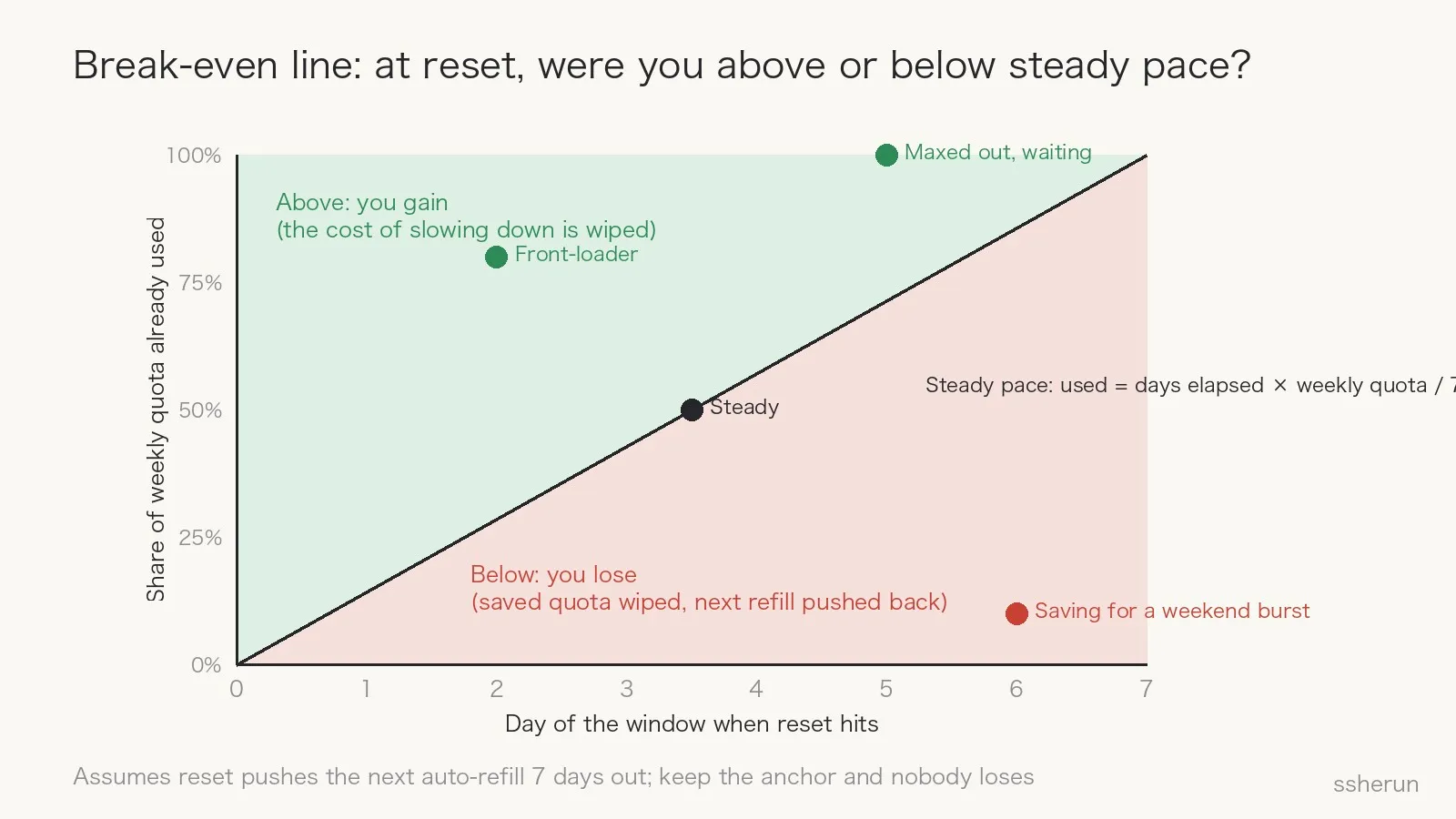
As a rule of thumb (#15, #144): if usage at reset is below “days elapsed × weekly quota / 7,” you lose.
How much? Take a concrete case (#95). The window starts on day 0; you have used only 10% by day 6, when a job needing 80% lands:
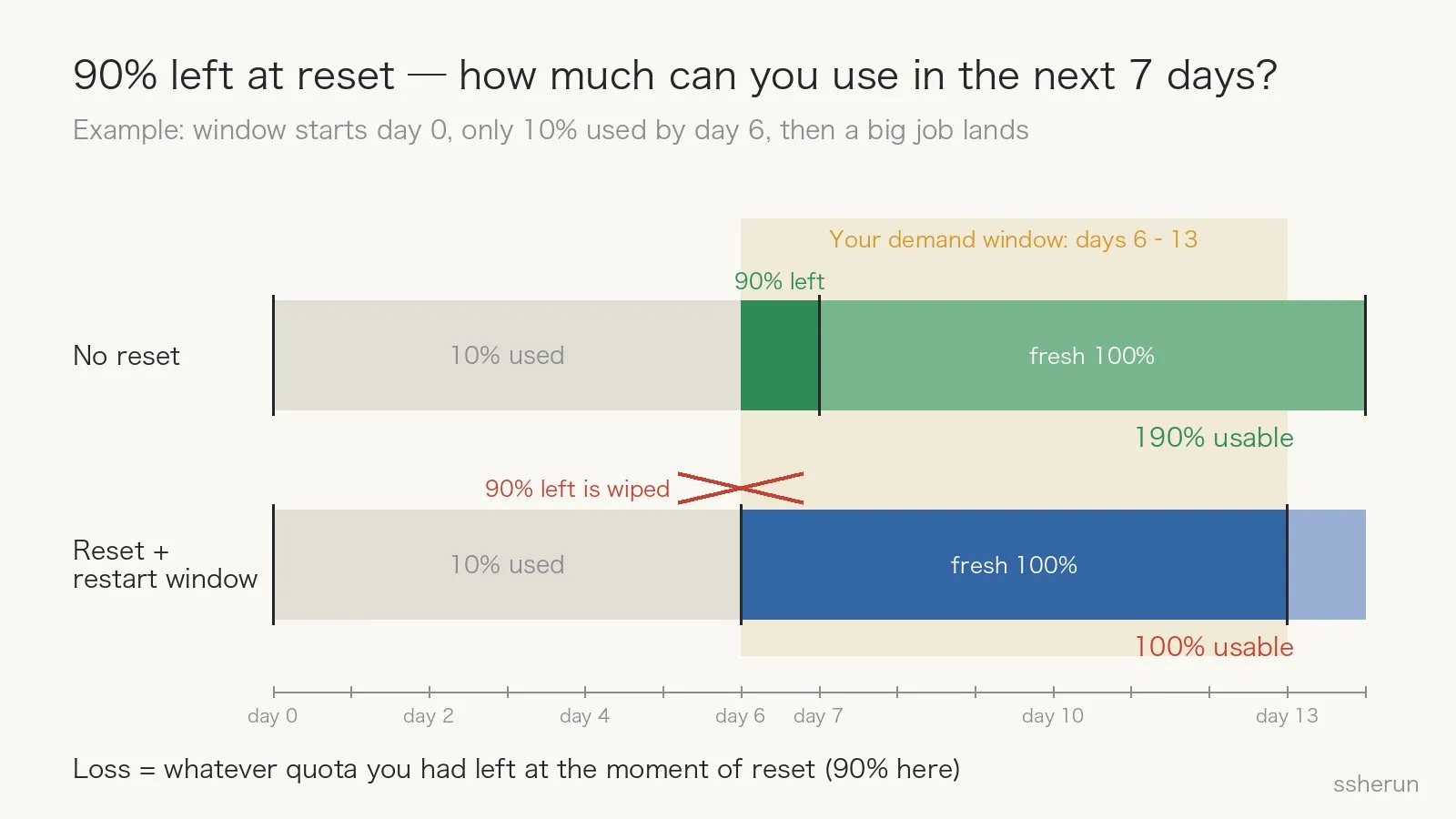
Without a reset, days 6–13 give you the remaining 90% plus a fresh 100% on day 7. With the reset, you get 100%. The loss equals exactly what you had left at the moment of reset.
Who actually loses
The damaged cases in the thread are not nitpicks:
| Case | What happens |
|---|---|
| Saving for a late burst (#95, #121) | You go light early to sprint at the end; the savings are wiped |
| Expiring, not renewing (#102, #111) | 40% left, you could use 140%; after reset, 100% |
| Work straddling the window boundary (#77, #116, #167) | A weekend release could draw on two windows; now one |
| Across a monthly subscription (#69, #53) | Four refills become three; one user’s simulator shows late-window users can lose up to 25% of a month |
| Just used a reset card (#48, #76) | You restarted your own window, then a global reset hit — card wasted |
The OP’s side has a point too (#24): over a long horizon, resets create more windows, so total supply rises.
Both sides are right against different baselines. The OP counts a month’s total supply; the critics count what they actually have during the days they need it. When demand can’t be deferred (#75), the latter is the real cost.
Through game theory: not a gift, a mechanism
Players and payoffs
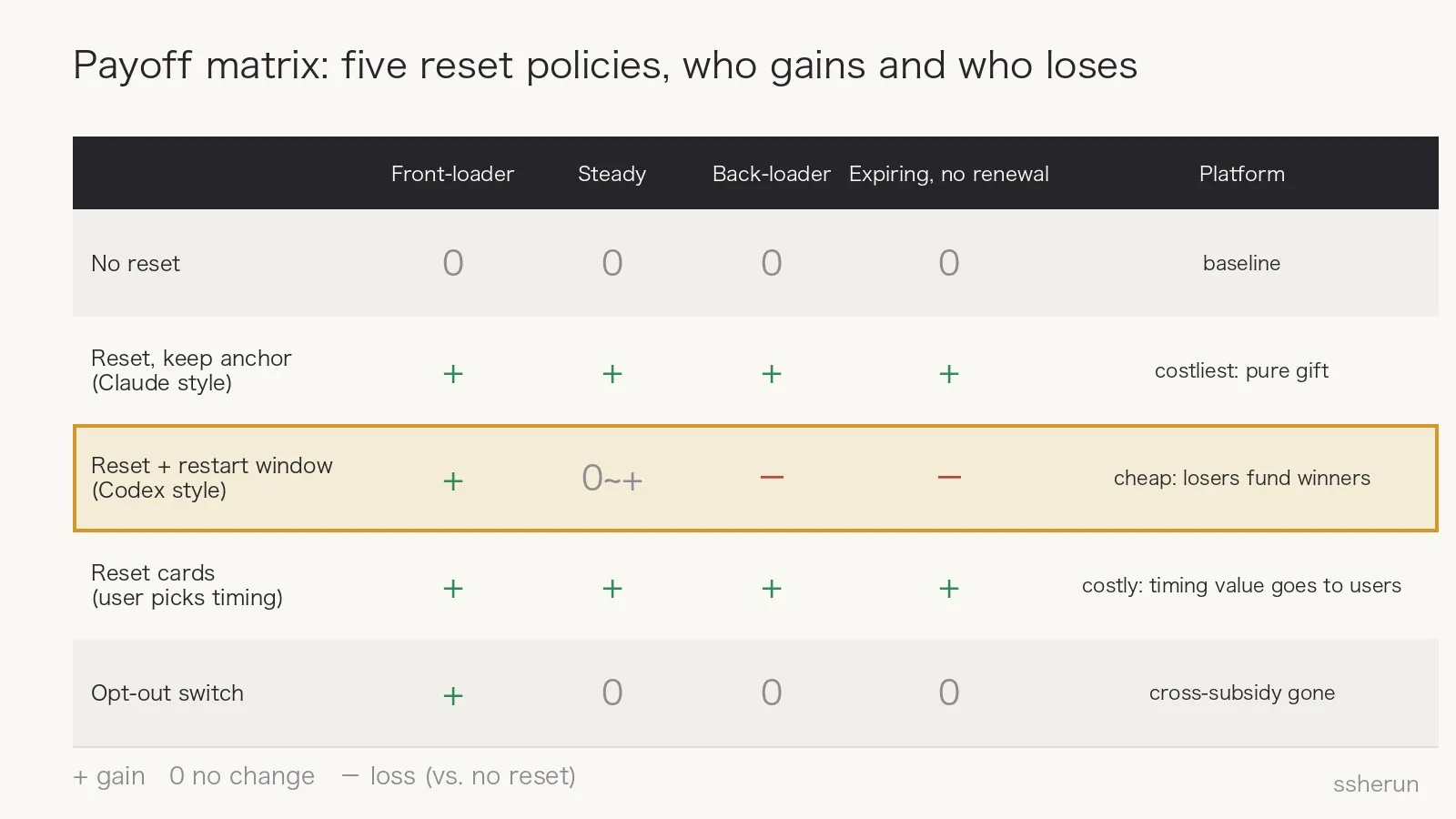
Split users by pacing: front-loaders, steady, back-loaders, and expiring non-renewers. The platform has at least five policies:
Line them up:
- Claude’s approach (refill quota, keep the refill date): everyone gains; costliest for the platform — a real gift.
- Codex’s approach (reset and restart the window): front-loaders gain, back-loaders and expiring users lose. Much cheaper for the platform, because losers fund winners.
Reply #53 nailed it: “This isn’t ingratitude. You gave my rice to someone else, and I’m supposed to thank the person who took it.”
The equilibrium: pacing gets punished
Normally, when future supply is uncertain, the rational move is to keep a buffer — economists call it precautionary saving.
Codex resets wipe exactly that buffer. So users’ best response changes:
- Saving has lower expected value; burning early becomes the dominant strategy.
- Everyone shifts consumption forward and hits the cap sooner.
- People who hit the cap are more likely to upgrade to a pricier plan (#171).
The platform doesn’t need to persuade anyone to use more; it only needs to make pacing costly. And since it can time resets for idle server capacity (#14), it can steer load too.
That is mechanism design: don’t change the price, change the rules, and let users walk themselves into the equilibrium you want.
Why there’s no opt-out switch
Some proposed a switch: people who think resets hurt can opt out (#126, #169). OP supporters liked it — opt out and stop complaining.
Reply #170 cut through: OpenAI will never do it. With a switch, everyone chooses what suits them: front-loaders opt in, back-loaders opt out. Nobody loses, and the cross-subsidy the platform relies on disappears.
It’s adverse selection, as in insurance: let participants choose and the pooled pool unravels. Reset cards work the same way — they hand users the option of when to reset, and options have value the platform won’t give away.
A repeated game: lopsided voices, eroding trust
This game repeats, with two asymmetries:
- Information: the platform sees everyone’s burn rate and can pick the timing that suits it; users can’t even measure their true quota (#29).
- Voice: winners cheer loudly; losers stay quiet or get mocked as bargain-hunters (#151). The platform always hears a rosier crowd.
Worse, the same period brought quota cuts and model-quality swings (#25, #40, #43), stacked on random resets. Users can’t untangle each effect and are left with one feeling: this plan is unpredictable.
Reply #186: users buy a plan for predictable quota and windows at a fixed price, not to pay for a lottery on when the next reset hits.
The metaphor fight: good ones keep the anchor
The OP’s set-meal analogy took the most heat, because it omits the key fact: the refill date moves. Better ones from the thread:
- Electricity card (#51): your landlord loads 100 kWh every Monday; you plan to run the dryer on the weekend. On Friday he force-refills you and announces the next top-up is now next Friday.
- Water in the desert (#80): one bucket lasts seven days. You ration for six to bathe on day seven; on the sixth night it’s refilled — but the next refill is seven days out.
- Tomorrow’s dinner (#100): halfway through dinner, the owner takes it and brings a new one — but it’s tomorrow’s.
All three keep the time anchor. Others warned (#49, #73): metaphors explain; they don’t prove. Define “loss” against a baseline first, then do the math.
For people building products
- Don’t move users’ anchors with perks or compensation: refill dates, billing dates, expiry dates. Move an anchor and it’s not a gift but a transfer.
- If you need to control cost, say so. Cutting quota by way of random resets gets repaid in lost trust.
- The same action can pay off in opposite directions for different users. Segment by usage rhythm before judging a policy; don’t go by averages or the loudest group.
- Predictability is part of the product.
For users
Under these rules, the rational response is: use early, save little; don’t plan big jobs across the window boundary; if you’re expiring and not renewing, burn what’s left now.
In the end, what the OP “couldn’t understand” wasn’t arithmetic. It was that different people stand in different places under the same rule. A rule that’s a gift to you can be a cost to someone else.
Comments