Distillation Through V2er Metaphors: Fishbowls, Kitchens, and Copying
Someone on V2EX asked: when AI people say “distillation,” is it basically fishing fish out of someone else’s bucket?
The technical definition is easy to look up. What’s useful is how the thread turned an abstract word into pictures—fishbowls, restaurant kitchens, tracing, car teardown, homework copying, bubble-tea formulas. Below is a metaphor-first distillation of that thread (without naming vendors).
Five metaphors on one loop
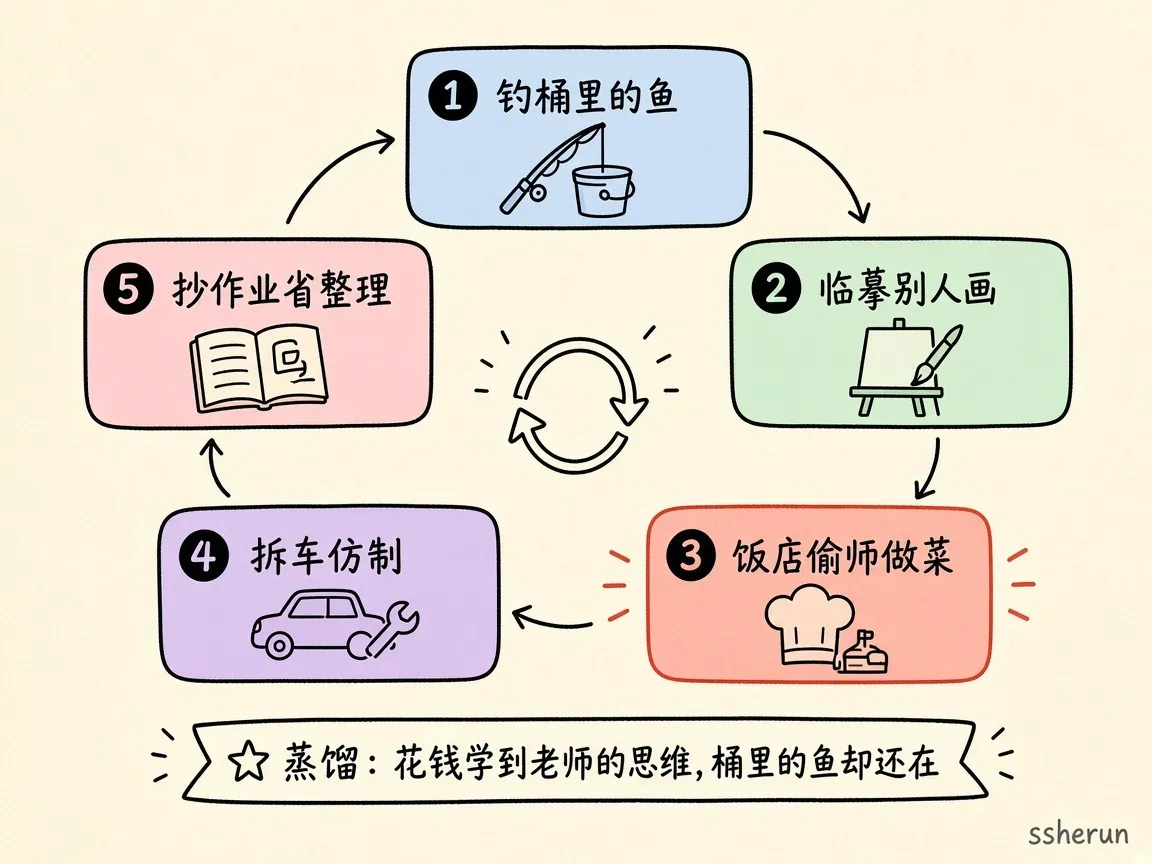
This hand-drawn ring is not a training pipeline. It’s the five sayings that kept showing up:
- Fishing in someone else’s bucket — the OP’s metaphor; others prefer “netting the bucket”
- Tracing someone else’s painting — the original stays; you leave with imitation
- Stealing kitchen skills at a restaurant — pay for the dish, peek at the kitchen, reverse the recipe
- Tear down a car and clone it — rent-only cars driven into a factory for reverse engineering
- Copy homework to skip the hard part — skip cleaning and trial-and-error; copy the classmate who already learned
The cleanest banner line: Distillation: pay to learn the teacher’s thinking; the fish is still in the bucket.
Metaphor map
| Metaphor | Intensity | What it tries to say |
|---|---|---|
| Fishbowl: fishing / netting / fish still there | Very high | You learn capability; the original usually remains; “netting” stresses batch scale |
| Fine dining → reverse-engineer the recipe / peek at the kitchen | High | Pay for the dish, then infer the method |
| Tracing someone’s painting / paint-by-numbers | High | Imitation and fitting, not physical theft |
| Teacher in class / pay tuition then teach others | Medium-high | The “learning” camp loves this; critics say teachers teach willingly, distillation often violates ToS |
| Rent-only car → drive it to a factory and take it apart | Medium | Rent-not-sell business model vs reverse learning |
| Copying homework / exam answers | Medium | Skip cleaning and trial-and-error; copy the classmate who already learned |
| Drag encyclopedia entries and reprint them | Medium | Source wasn’t fully original either, but curation cost gets skipped |
| Bubble-tea formula reverse-engineered | Medium-low | A hard-won recipe ratio gets copied |
| Buy a car, disassemble, clone (pre-patent world) | Medium-low | Cloning still needs skill; law may not ban it |
| Pay someone to hold up the fish so you can photograph it | Low | A paid snapshot ≠ owning the bucket |
| Paid survey report rebuilt as a competing platform | Low | Pay to read a report → resell a clone platform |
| The fish might be honey | Low | Fishing in someone else’s bucket can be a trap |
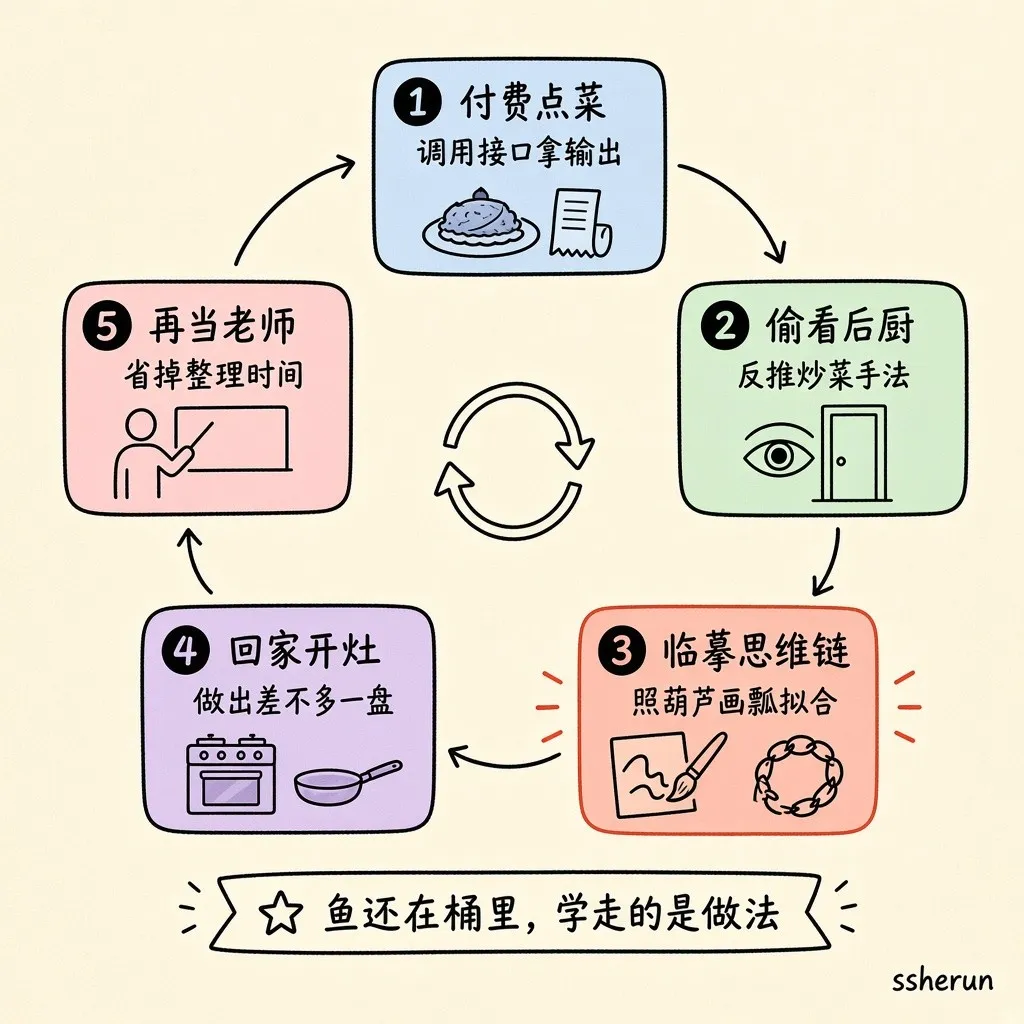
The most useful frames
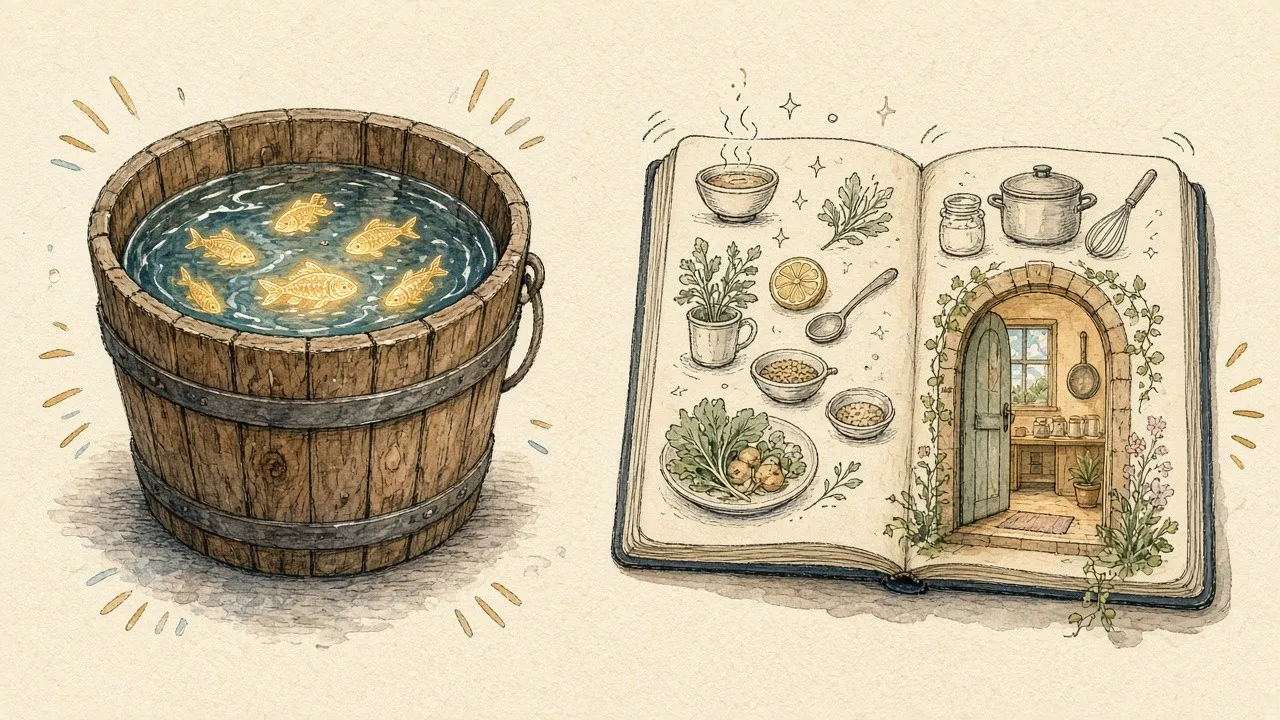
1. The fish is still in the bucket
Several people punched the hole in the original metaphor: distillation usually doesn’t remove the fish. You learn method and pattern; the other service remains—“but the fish is still in the bucket.”
Others prefer “net the whole bucket”—batch and efficiency. Someone else warns: the fish might be a honeypot. Another line: pay someone to hold up the fish for a photo—snapshot ≠ owning the bucket.
2. Tracing, not moving
“Tracing someone’s painting,” “paint by numbers,” and “learn by copying” landed better than “fishing”: the original stays put; you leave with a transferable imitation. One correction: fishing is wrong because distillation means “yours stays; I learned yours.”
3. Ordering at a restaurant + peeking at the kitchen
A high-frequency line: eat at a top restaurant, then reverse-engineer how to cook; or order a dish, peek through the kitchen door, go home and cook something close enough.
The follow-up matters too: the chef’s dish may not be fully original either—maybe they read cookbooks and adapted. Mutual “dirty origin” accusations get baked into the metaphor.
Bubble-tea version: you spent forever dialing in a formula; they reverse the ratios and ship a clone.
4. Car teardown vs just driving a lot
One camp uses “rent-only car → factory teardown” for the business-model conflict. Another sharpens it: maybe nobody took the car apart—they just drove hundreds of thousands of kilometers across scenarios. That sounds more like behavior distillation than weight theft.
The buy-and-clone version stresses: cloning still needs skill; there may simply be no statute that bans distillation yet.
5. One technical sentence
Supervised learning: same inputs, fit the student to the teacher’s outputs as ground truth. What often matters most is CoT—final answers alone don’t transfer well; tricks exist specifically to recover intermediate reasoning.
Another line: early LLMs paid for massive human labeling; distillation lets an already-good model do the labeling. Someone else notes: distillation doesn’t steal the objective’s weights; the harsher move is a proxy that just calls someone else’s API.
The fight isn’t about metaphors. It’s about permission.
Four camps showed up:
- Pay-and-done: I paid for outputs; reuse and retrain are my business.
- License/ToS: Payment still obeys terms; unauthorized distillation is your risk if caught.
- Double-standard: Everyone scrapes the web; “I may grab, you may not learn from what I grabbed” doesn’t hold.
- Complexity: Stable controversy means don’t rush to play judge.
The encyclopedia metaphor hardens “plagiarism”: the source wasn’t fully original either, but curation cost gets skipped—you take the finished entries. The other side lifts “pay tuition, then become a teacher”: if you paid for knowledge, is teaching others also stealing from your teacher?
One-line takeaway
Distillation ≈ obtain teacher outputs (paid or in violation), then fit behavior and chain-of-thought; the fish usually stays in the bucket. The real argument is whether learning the method counts as study, plagiarism, or breach.
Source: V2EX #1241338
Comments