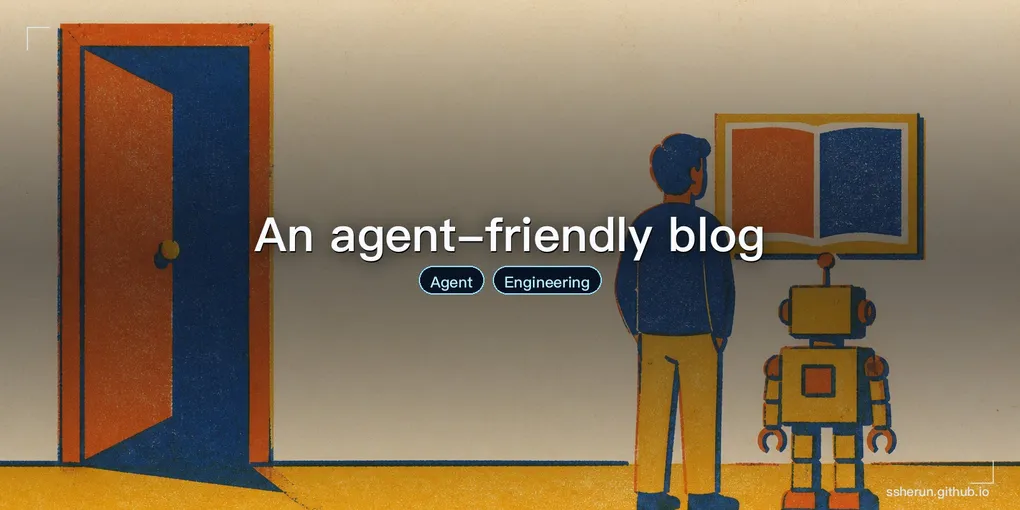
An agent-friendly blog
Why be agent-friendly?
The old logic of a personal site is simple: a person arrives, sees a polished page, reads, and leaves.
In 2026, humans are no longer the only visitors. More and more AI agents browse, collect, and summarize on a user’s behalf. When an agent hits a typical blog, it faces a pile of HTML, CSS, and JavaScript — noise it does not need.
Agent-friendly means your content also exists in a form machines can consume efficiently. The site should have a face (HTML) and a brain (structured data plus plain-text interfaces).

What this site does
1. llms.txt — a map for LLMs
llms.txt is an emerging convention, a cousin of robots.txt with the opposite job: not “stay out,” but “if you came, start here.”
This site’s /llms.txt is generated at build time. It includes:
- a short site and author intro
- titles, links, and summaries for every post
- a sketch of the site structure
- pointers to full content
An agent can read one file and understand the whole site.
2. llms-full.txt — the full context
For agents that need depth, /llms-full.txt concatenates every post’s Markdown into a single document. One request, the whole knowledge base — no page-by-page crawl.
3. Raw Markdown endpoints
Every article has a matching .md URL. This English post lives at /en/blog/hello-world.md; the Chinese original is /blog/hello-world.md.
That follows the llms.txt recommendation: give each page a plain Markdown twin so a machine can skip HTML parsing and take structured text.
4. JSON-LD
Each HTML page embeds Schema.org BlogPosting JSON-LD: title, description, publish time, author, language, and keywords. Search engines and AI crawlers can parse the metadata without guessing.
5. Open discovery
/robots.txt— crawlers are welcome/rss.xml— RSS/sitemap-index.xml— sitemap<link rel="help" href="/llms.txt">— a discovery hint in the HTML head
These endpoints are generated
None of the agent-facing files are hand-maintained static copies. Astro builds them from the content collection. Write a new post and llms.txt, llms-full.txt, and the .md endpoints update themselves.
Zero upkeep is the only version that lasts.

6. Obsidian-style wikilinks
The Markdown pipeline understands Obsidian wikilinks, so notes can ship from an Obsidian vault without rewriting links.
Supported forms:
[[post-slug]]— link to a post[[post-slug|display text]]— custom label[[post-slug#heading]]— jump to a section![[image.png]]— embed an image
For more systems and Windows notes, see PECMD commands in WinPE and VS ATL exe template cannot generate a DLL.
What next
This is a starting point. Following the idea of what a personal site becomes in the agent era, later experiments could include:
- A conversational knowledge persona — an agent that actually knows everything you have written
- Structured capability, not just essays — interactive playgrounds
- Intent-aware visitor interfaces — different responses for different kinds of visitors
Don’t just display yourself. Deploy yourself.
Comments